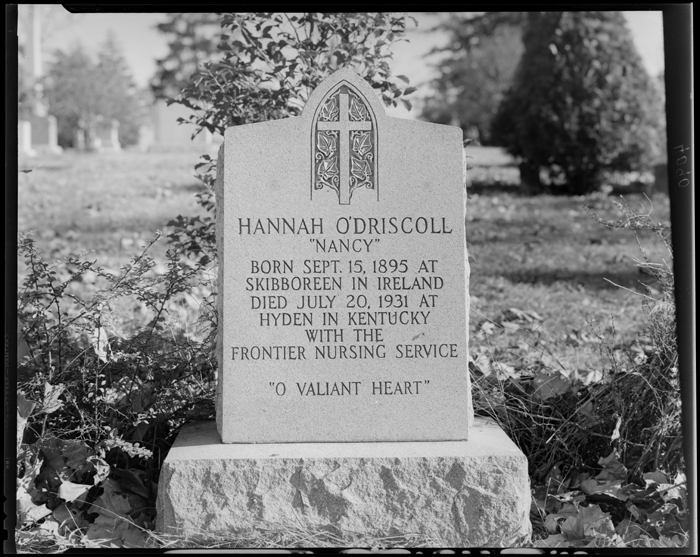
Hannah “Nancy” O’Driscoll was remarkable in many ways but like most nurses from the last century she remains largely unknown.
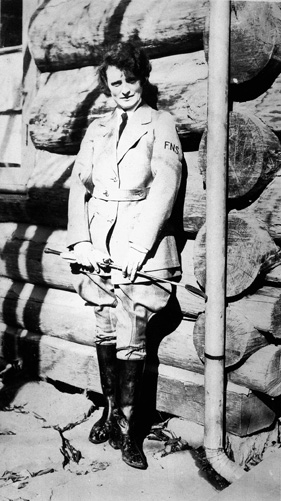
She was a nurse midwife with the Frontier Nursing Service in Kentucky which had been modelled on the Highlands and Islands Medical Service in Scotland.
If you’re new to the FNS here’s a good starter and part two. And Chelsea Gorham’s wonderful documentary Angels on Horseback (57 min) is a joy to watch.
I knew about Nancy but found out more revisiting some source material.
Her death from a burst appendix sparked a torrent of grief in the poor remote community she served.
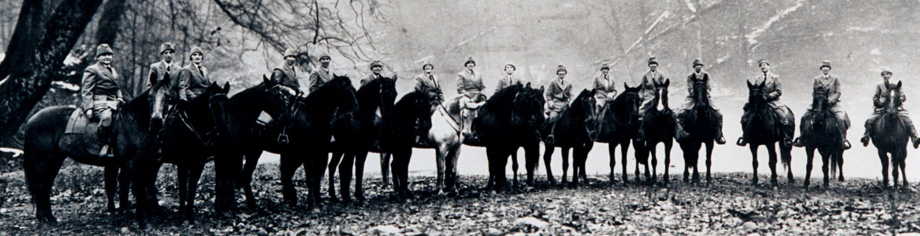
The FNS recruited British-trained nurses because of the lack of midwifery training in the USA. Most were the elite Queen’s Nurses who had secured additional qualifications in midwifery and health visiting after hospital training.
They had to be able to ride, take a nickname, and work autonomously in extremely difficult conditions.
Nancy was born in Skibboreen, West Cork, and later served as a nurse in Malta and Constantinople during World War One.
At this time she met Annie Mackinnon from Skye. Annie had served with the French Flag Nursing Corps and was one a very few nurses to be awarded the Croix de Guerre. The citation referred to her continuing to care for sick and wounded soldiers under fire in the early summer of 1918.
After the war, Nancy worked with Queen’s Nurses in Manchester and later upped sticks to the USA take up a post at a maternity hospital in the north. At Annie’s suggestion she decided to come south to Kentucky to join her at the FNS.
Mary Breckinridge, founder of the FNS, invited journalists to visit Kentucky – this was essential to maintain keep the funds coming in. One of them, Ernest Poole, wrote a book Nurses On Horseback (1932). Chapter XI gives a good insight into Nancy’s professional and personal life.
Poole himself was no slouch as a journalist and novelist. In 1918 he won the first ever Pulitzer Prize for fiction.
The starting point of the interview was Annie disarmingly telling him that she did not have any stories about Nancy “only just bits in the day’s work.”
She recalled: “Nancy worked hard and she worked well. And she kept such accurate records of every case coming under her care that, when our superior checked them up at the time of her death, she found not an omission or mistake. But hard as she worked, she took it lightly. Her sense of humor was never far off.”
Nancy cut a distinctive figure with her long red hair on her horse, Raven. Against the advice of colleagues she started a clinic in the small hamlet of Cutshin.
Annie recounted: “They liked her and they liked her work. She was straight as a die, with those she served, and never spoiled them. Indeed, she bullied them instead.
“She saw them them just as they were,the good and bad, the weak and the strong. She faced life in all its situations But though she knew life both good and bad, it was the good that she believed in.
“But they came by scores to her clinic at Cutshin.
“The clinic there was her own idea. We warned her against it at the start, for Cutshin was a long way off in a lonely district of the hills and to get there, your horse had to climb up over some of our steepest mountains and ford the river twice besides.
“More than once, with my heart in my mouth, I’ve watched Nancy swim her horse over the wildest river in spring. Nothing could keep her away from her clinic. The mothers and children over there had no other medical care. They needed her. And that was enough.
“Now and then, as time went on, she began to have a pain in her side. She made light of it and went on with her work, and she rode away one morning, without ever telling us that she was having another attack.
“She had not only her clinic, that day, but three maternity patients to examine, before and after birth. The two pre-natals weren’t coming just right and Nancy was keeping an eye on them. Her pain must have grown to an agony but still she kept on about her work and didn’t get home till the edge of the dark”.
Nancy went to her bed. An FNS doctor and surgeon were called and a burst appendix diagnosed, which in the pre-antibiotic era was usually fatal.
More than 300 of her patients followed Nancy’s coffin down the mountain to the road to Lexington.
She was only 35. An exceptional nurse. Well remembered then. And not forgotten now.
Categories: digital history, history on the web, medical and nursing, nursing history


Leave a comment